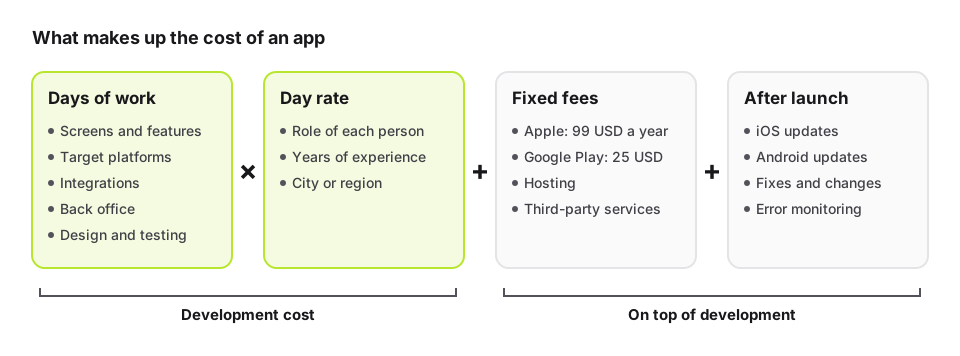
How much does an app cost? No serious price comes without a scope: the cost of an app is the number of days of work it takes, multiplied by the day rate of the people who build it, plus fixed fees and maintenance after launch. This guide gathers the day rates published in a French rate barometer, the official App Store and Google Play fees, and what pushes the number of days up or down.
Why do app prices vary so much?
Two projects both called an "app" can have nothing in common: a booking app with a few screens and a calendar, and an ordering app with payment, delivery tracking, customer accounts and a back office. Their prices are not comparable, because the work behind them is not.
So be wary of price ranges given without a scope. The sum that holds is always the same: days of work, per role, multiplied by a day rate, then what comes on top once or every year (developer accounts, hosting, third-party services, maintenance).
What does an app developer charge per day?
Silkhom, a recruitment firm, publishes a day-rate barometer with its method. Its 2025 edition is based on its placements, its clients' job descriptions and data from more than 20,000 freelancers analyzed from 2019 to 2025, and gives ranges by role, experience and area (Paris, the largest cities, the regions). Treat them as orders of magnitude: the figures come from Silkhom's recruitment business, and Silkhom notes that its averages take experience and programming languages into account and should be weighed against each field's own dynamics.
According to that barometer, read on September 29, 2026, here are the ranges per day in Paris, by role and experience:
- iOS, Android or cross-platform developer (React Native, Flutter, Ionic): €330 to €430 as a junior (0 to 2 years), €400 to €500 mid-level (2 to 5 years; €400 to €550 for Android), €500 to €650 senior (over 5 years), €600 to €720 for a lead developer (over 8 years)
- The same developers in the regions, outside Paris and the largest cities: €300 to €380 as a junior, €450 to €550 for a lead developer
- UI/UX designer: €350 to €450 junior, €430 to €530 mid-level, €450 to €580 senior
- Digital project manager: €430 to €500 junior, €550 to €650 mid-level, €600 to €800 senior
- Functional tester: €400 to €480 junior, €450 to €550 mid-level, €500 to €650 senior
What drives app development cost?
A day rate tells you what a day costs, not how many you need. A team brings several roles together (development, design, project management, testing), and the days each one needs depend on what the app has to do. The items that weigh:
- Scope: the number of screens and user journeys, and above all the features behind them, such as user accounts, search, notifications or offline mode.
- Platforms: iOS, Android, a web version, or all three. Each added platform means more development, more testing and one more release.
- Integrations: payment, CRM, ERP, maps, messaging or a partner's API. Each one has to be built, tested and followed up when the third-party service changes.
- The back office: the interface where your teams manage content, users and orders, to include from the first estimate.
- Design: starting from an existing interface kit or creating custom screens, tested with users.
- Security and personal data: authentication, encryption, consent, logging. France's data protection authority, the CNIL, has published recommendations for mobile apps aimed at publishers and developers alike.
- Testing: on real devices, across several screen sizes and operating system versions.
- What already exists: taking over an app or connecting to an older system starts with understanding it.
Native or cross-platform: which costs less?
A native app available on iPhone and Android is written twice: in Swift for iOS and in Kotlin for Android. A cross-platform app, built with Flutter or React Native, shares most of its code between the two systems, with native parts where a device feature requires them.
Most of the difference is not in the day rate: in Silkhom's barometer, the ranges for iOS, Android and cross-platform developers are almost identical. The gap comes mostly from the number of days, with one code base instead of two to write, test and maintain. Native still makes sense for demanding graphics or features closely tied to the device.
And if your users only come now and then, a well-built website may be enough: no store, no developer account, one version to maintain.
What fees come on top of development?
To publish on the stores, you need a developer account, ideally in your company's name. According to Apple, the Apple Developer Program annual fee is 99 USD, in local currency where available, and prices may vary by region. According to Google, registering for Play Console takes a one-time 25 USD fee.
Then come server and database hosting, and third-party services billed by use: sending emails or text messages, maps, payments. If the app sells subscriptions or digital content, also read Apple's and Google's commission terms before you set your prices. Ask for each of these costs to appear in the quote, even when you pay it directly.
What does an app cost after launch?
An app is never finished, because Apple and Google raise their requirements regularly. Since April 28, 2026, Apple only accepts apps uploaded to App Store Connect that are built with Xcode 26 or later and a version 26 SDK, such as iOS 26's. Since August 31, 2026, Google Play requires new apps and app updates to target Android 16 (API level 36) or higher. An existing app, for its part, must target at least Android 15 (API level 35) to remain available to new users whose devices run a newer version of Android than the one it targets.
So plan a recurring budget for these updates, fixes, error monitoring, hosting and the changes your users ask for. Its size depends on the app: ask for it to be priced separately in the quote, with what it covers.
How do you get an app quote you can rely on?
Describe the problem to solve, the users, the tools to connect and what must be in the first version, then send the same brief to every provider: that is what makes quotes comparable. If the scope is still unclear, a paid discovery phase pins it down before you commit to the whole build. In each quote, check:
- The number of days per role (development, design, project management, testing), not just a total
- What is included: back office, testing on devices, release to the stores, documentation
- The contract model: fixed price on a frozen scope, or time and materials when needs will change
- Maintenance after launch, priced separately
- Who owns the code, the developer accounts and the data
Key takeaways
- The cost of an app: days of work multiplied by a day rate, plus fixed fees and maintenance
- According to Silkhom (2025), a senior mobile developer charges €500 to €650 a day in Paris
- Native or cross-platform, the cost gap comes mostly from the number of days: one code base instead of two
- Apple charges 99 USD a year, Google Play 25 USD once, and both raise their requirements regularly
FAQ
How much does a mobile app cost?
There is no standard price: it depends on the number of days of work, set by the screens, features, platforms and integrations, multiplied by each role's day rate. To place the rate, Silkhom's 2025 barometer puts a mid-level mobile developer in Paris at €400 to €500 a day (up to €550 for Android). For a price, you need a quote on a written scope.
How much does it cost to publish on the App Store and Google Play?
According to their official pages, the Apple Developer Program costs 99 USD a year (in local currency where available) and registering for Google's Play Console costs a one-time 25 USD. Open these accounts in your company's name, not your provider's, so you stay in control of your apps.
Is a cross-platform app cheaper?
Often, because one code base serves iOS and Android: fewer days of development, testing and maintenance. The day rate varies little from one technology to another: Silkhom gives almost identical ranges for iOS, Android and cross-platform developers. Native makes sense for demanding graphics or features closely tied to the device.
Do you need a budget after launch?
Yes. Apple and Google raise their requirements regularly: Apple no longer accepts an update built with an old SDK, and an app that targets too old a version of Android is no longer offered to some new Google Play users. Hosting, fixes and new features come on top.
Fixed price or time and materials for an app?
Fixed price fits when the scope can be written down and accepted before work starts; time and materials, when needs will change with user feedback. A hybrid is possible: a fixed price for the first version, then time and materials for what follows.
Sources
- Silkhom: Baromètre des TJM 2025 dans l'informatique et le digital (accessed September 29, 2026)
- Apple Developer: Program enrollment (accessed September 29, 2026)
- Play Console Help: Get started with Play Console (accessed September 29, 2026)
- Apple Developer: Upcoming Requirements (accessed September 29, 2026)
- Play Console Help: Target API level requirements for Google Play apps (accessed September 29, 2026)
- CNIL: Mobile applications, CNIL publishes its recommendations for better privacy protection (accessed September 29, 2026)