All three connect your software and chain actions from a trigger. They differ on three points: what they bill (a complete execution for n8n, an operation per module and per item for Make, a task per successful action for Zapier), where your data runs, and whether you can host the tool yourself, which n8n offers. The right choice depends on how many steps your workflows have, your volumes and your constraints on data.
n8n, Make and Zapier: what is the difference in short?
All three do the same basic job: a trigger (a form, an email, a date) starts a series of actions in your tools, with no retyping. You build them visually by linking blocks.
What sets them apart shows on the invoice and in the contract: the unit billed, where the data is hosted, and the choice between an online service and an installation on your own servers. Each vendor changes its plans regularly: the points below come from their official pages, read on the date given in the sources.
How does each tool bill?
Each counts a different unit:
- n8n counts executions: an execution is one complete run of the workflow, however many steps or however much data it handles.
- Make counts credits: for apps without AI, one operation is one credit. An operation is one module run on one item of data, which Make calls a bundle; the trigger counts one operation per check.
- Zapier counts tasks: a task is a successful action. Triggers, filters, paths and the formatter do not count, nor do actions that fail.
On the same workflow, what does each tool count?
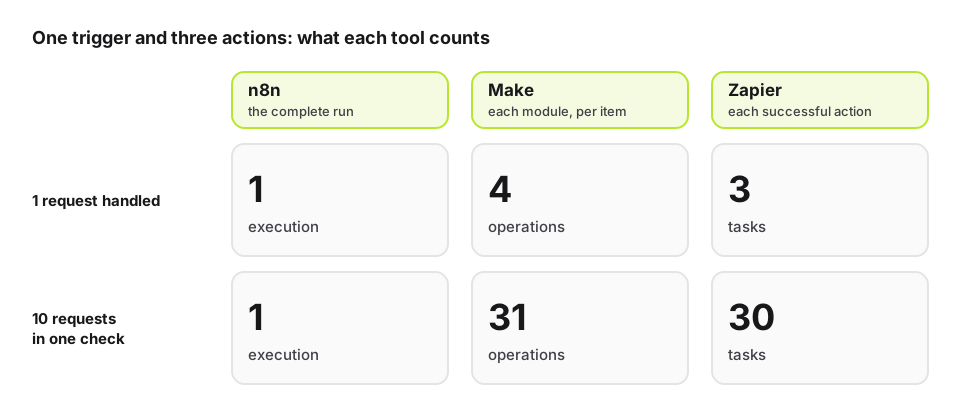
Take a simple workflow: a trigger, then three actions. If it handles a single request, n8n counts one execution, Make four operations (the trigger and three modules) and Zapier three tasks (the three actions).
The gap grows with volume. Make gives its own example: a form that returns 10 responses in one check, followed by three modules, uses 31 operations per run. In Zapier, each successful action counts one task per item it handles: Zapier's own example counts two tasks for two new leads sent to a CRM, so 10 responses handled by three actions make 30 tasks. In n8n, if one check picks up the 10 responses, the run is still one execution; if each response arrives on its own through a webhook, n8n counts one execution per response.
This does not say which one costs less: the price of each unit differs by tool and plan. Estimate your volumes, then do the sums on the official price lists of the day.
Where does your data run?
n8n Cloud stores data in the European Union, on servers in Frankfurt. If you self-host n8n, the data stays wherever you install it.
Make runs in several zones, European (eu1, eu2) and American (us1, us2). On the Enterprise plan, you migrate your data to a dedicated server in your region. The pages cited here do not say where each zone stores its data: ask Make about yours.
Zapier hosts data on AWS servers in the United States and does not offer EU-only storage. It is certified under the EU–US Data Privacy Framework, the framework that allows these transfers from Europe.
For customer or employee data, this often weighs more than price: check it with whoever handles GDPR before you build.
Can you host it yourself?
n8n can: its Community edition is free and self-hosted, with almost the complete feature set; Business and Enterprise editions are enabled with a license key. Hosting, backups, updates and server security are then yours.
Make and Zapier, as the pages cited here describe them, are online services hosted by the vendor: nothing to install or maintain, but you depend on the vendor's terms and on where it hosts the data.
What about AI steps?
All three can call an AI model, each with its own billing rules. Make bills its built-in AI features in credits based on tokens and operations; if you connect your own OpenAI or Anthropic account, Make bills the operations and you pay the provider for tokens (for Make's built-in AI apps, this option needs a paid plan). In Zapier, an "AI by Zapier" step uses tasks according to the model tier you choose. In n8n, an AI step is one more step of the execution, which counts once.
In every case, keep a person approving any action that commits the business: an email to a customer, a payment, a deletion.
Which one should your business choose?
A few pointers, to check against your own volumes:
- Zapier: built for people who do not code, with more than 9,000 apps announced and a free plan of 100 tasks a month. Suits small volumes, if hosting in the United States works for you.
- Make: visual scenarios and European zones. Watch the number of items processed, which multiplies operations.
- n8n: billing per execution keeps the count low on long or high-volume workflows, and self-hosting keeps the data with you, if you have the skills to run a server.
- Beyond that: when the workflow becomes an application in its own right, with an interface or rich business logic, custom development takes over.
Key takeaways
- n8n bills the complete execution, Make each module on each item, Zapier each successful action
- The more steps and items a workflow has, the wider the gap between the counts
- n8n Cloud is hosted in Frankfurt, Make has European zones, Zapier hosts in the United States
- n8n also installs on your own servers, with a free Community edition
FAQ
Is n8n cheaper than Zapier?
Not necessarily. n8n counts one execution per run, Zapier one task per successful action, and each unit is priced differently. On long or high-volume workflows, n8n's count is lower; for a few actions a month, Zapier's free plan may be enough. Do the sums on your volumes with the official price lists.
Make or n8n for a small business?
Both run online with nothing to install: n8n Cloud in Frankfurt, Make in its European zones. The difference is in the count: n8n counts one execution per run, Make one operation per module and per item, so n8n's count stays lower on workflows with many steps or items. n8n can also be installed on your own servers, if you have the skills to maintain it.
Can you move from Zapier or Make to n8n?
Yes, by rebuilding each workflow in n8n. It is a chance to document them, remove the ones no longer used and plan error monitoring.
Which one is GDPR compliant?
No tool is compliant on its own: compliance depends on your data, where it is processed and the contracts signed. n8n Cloud stores data in Frankfurt and self-hosted n8n keeps it on your servers; Make offers European zones, so ask Make where yours stores data; Zapier hosts it in the United States, under the Data Privacy Framework.
Sources
- n8n Plans and Pricing (accessed September 29, 2026)
- n8n Docs: Choose how to use n8n (accessed September 29, 2026)
- Make Help Center: Credits (accessed September 29, 2026)
- Make Help Center: Operations (accessed September 29, 2026)
- Make Help Center: Allow connections to and from Make IP addresses (accessed September 29, 2026)
- Make Help Center: Upgrade to the Enterprise plan (accessed September 29, 2026)
- Zapier Plans & Pricing (accessed September 29, 2026)
- Zapier Help: How is task usage measured in Zapier? (accessed September 29, 2026)
- Zapier Data Privacy Overview (accessed September 29, 2026)